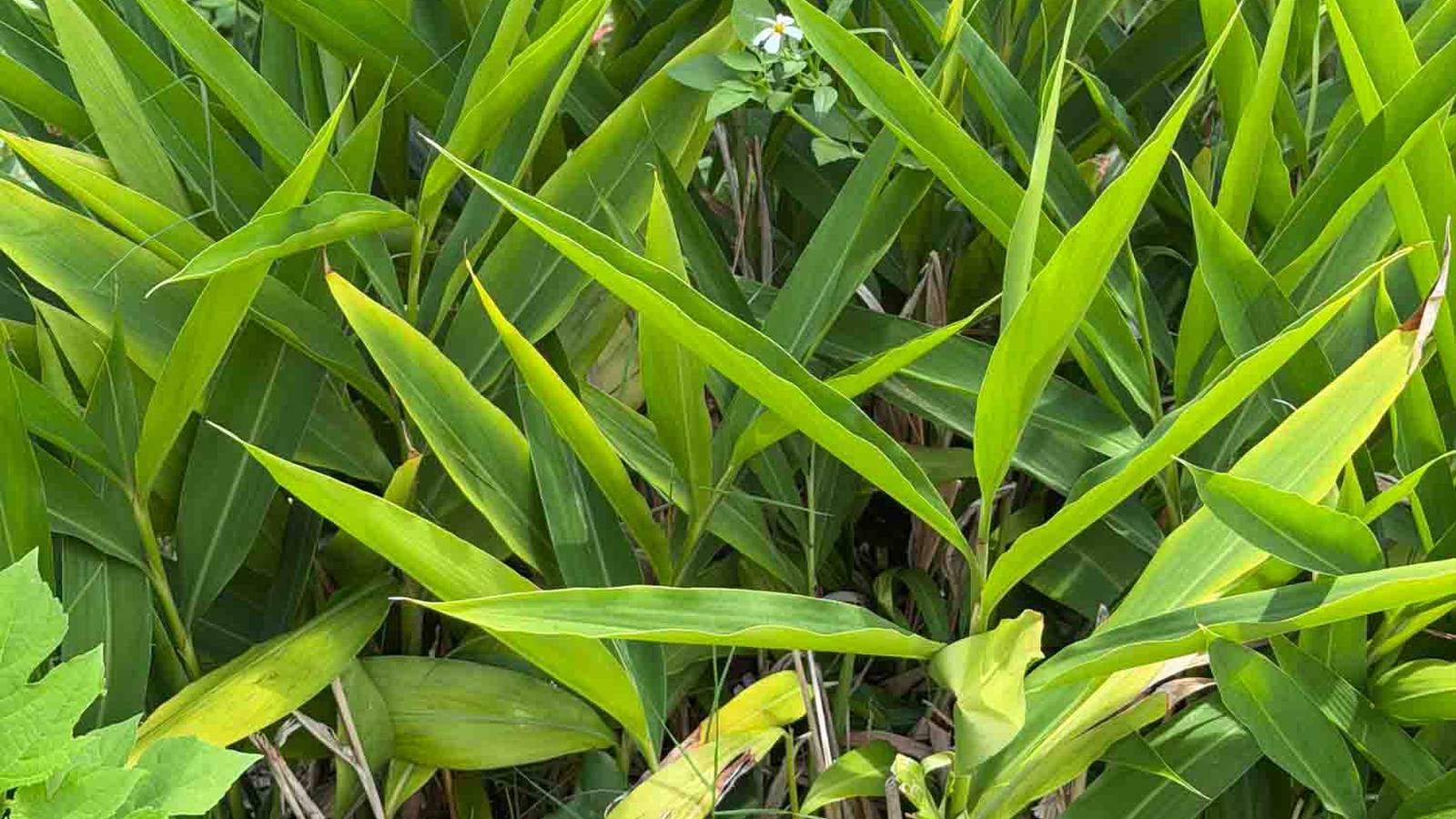
The Ginger Guild
Twelve+ Varieties Across Four Genera
The grove's ginger collection spans four botanical families within Zingiberaceae — true gingers (Zingiber), shell gingers (Alpinia), wild gingers (Curcuma/Boesenbergia), and spiral gingers (Costus). Each genus has its own lead compound. Together they form a phytochemical toolkit that rivals a well-stocked apothecary.
Zingiber
True Gingers
Lead compounds: gingerols (fresh) → shogaols (dried/heat). Anti-nausea, anti-inflammatory, circulatory.
Common Ginger
Zingiber officinale
The workhorse. Gingerols (fresh) are potent anti-nausea, anti-inflammatory, and circulatory compounds. Shogaols (formed when dried or heated) are 2–4× more bioactive and have demonstrated anti-tumor properties against multiple cancer cell lines. One of the most clinically studied medicinal plants in the world.
Panduratin → no. Gingerols + [6]-shogaol → yes. Anti-nausea, digestion, joint inflammation.
Best: 1-inch slice fresh in any hot brew. Dry + grind for powder storage.
Shampoo Ginger
Zingiber zerumbet
Distinctive cone-shaped flower heads that fill with fragrant liquid as they mature — the traditional hair wash. Medicinally, the rhizome contains zerumbone, a sesquiterpene with significant anti-cancer, anti-inflammatory, and antiparasitic activity studied extensively in Southeast Asian research. Flavor is sharper and more camphor-like than common ginger.
Lead compound: zerumbone (anticancer, anti-inflammatory, antiparasitic). Unique to this genus.
Best in hot brew — zerumbone extracts well with heat. Use half the amount of common ginger (more pungent).
Alpinia
Shell Gingers & Galangals
Lead compounds: galangin, ACA (1'-acetoxychavicol acetate), antihypertensive peptides. Cardiovascular, antifungal, antiviral.
Thai / Greater Galangal
Alpinia galanga
The galangal in Thai cooking. Its lead compound ACA (1'-acetoxychavicol acetate) has demonstrated potent anticancer activity — one of the most studied natural anti-tumor compounds in Asian research. Also strongly antifungal and antiviral. Sharper, more piney flavor than common ginger; can't be substituted by it in a recipe.
ACA → anticancer, antifungal, antiviral. Galangin → anti-inflammatory, xanthine oxidase inhibition (gout support).
Best used fresh, thin-sliced, in cold brew or added to hot brews in the final 3 min. Heat degrades ACA.
Shell Ginger / False Cardamom
Alpinia zerumbet
The ornamental pink-white shell flowers are just the surface. Leaf tea and rhizome both contain antihypertensive peptides — some of the strongest plant-based blood pressure support compounds outside of pharmaceuticals. Diuretic and antioxidant. The aroma is a cardamom-floral hybrid that makes it one of the most pleasant additions to cold brews.
Antihypertensive peptides + kavain. Blood pressure, diuretic, antioxidant. Leaves can be brewed too — not just the rhizome.
Fresh leaves (3–4) + sliced rhizome in cold brew. The floral aroma is strongest cold.
Pink Perfection
Alpinia hainanensis
Chinese medicine galangal from Hainan. Related to shell ginger with a slightly different aromatic profile — warmer, spicier. Traditional use as a warming digestive, blood circulation support, and pain reliever. Beautiful in the landscape; the rhizome is smaller and more concentrated than Greater Galangal.
Flavonoids, essential oils, warming circulatory compounds. Traditional warming digestive and pain reliever.
Treat like shell ginger — fresh in cold brew, or use the rhizome sparingly in hot brews.
Boesenbergia & Curcuma amada
Fingerroot & Mango Ginger
The unusual two. Each has a unique lead compound found almost nowhere else in the plant kingdom.
Fingerroot (Chinese Keys)
Boesenbergia rotunda
Multiple finger-like rhizomes — the "keys" shape. Lead compound panduratin A is one of the most exciting compounds in recent antiviral research: demonstrated inhibitory activity against SARS-CoV-2 in a high-content cell-based screening study,2 anti-HBV (hepatitis B virus), and anti-cancer activity. Used in Thai and Malaysian cuisine — slightly bitter, citrusy, complex.
Panduratin A → anti-SARS-CoV-2, anti-HBV, anticancer, anti-inflammatory. Studied at Nature journal level. Rare to have this growing in a home garden.
Best fresh, thinly sliced. Use conservatively — strong flavor. Excellent paired with lemongrass in cold brew.
Mango Ginger
Curcuma amada
Looks like turmeric, smells unmistakably like raw mango — one of the most startling sensory surprises in the ginger family. No curcumin-style pigment. Instead: amadaldehyde, amadannulen, and enterokinase — a digestive enzyme that breaks down proteins. Antioxidant, anti-inflammatory, antifungal, and antiallergic. Used in Indian Ayurveda as an appetizer and digestive.
Amadaldehyde (unique), enterokinase enzyme (protein digestion), antifungal, antidiabetic pathway via GSK-3β/Nrf2. Impossible to replicate with any other ingredient.
Fresh only — the mango aroma disappears entirely with heat. Grate into cold brew alongside lemon verbena. A genuine conversation-starter in the cup.
Costus
Spiral Gingers
Technically Costaceae, not Zingiberaceae — a separate family that shares the rhizomatous tropical habit. Traditional medicinals across Africa, Asia, and the Americas.
Spiral Orange
Costus barbatus
Tall spiral-stemmed plant with striking orange cone flowers. The Costus genus has a long history in traditional medicine across Africa, Asia, and the Americas — diuretic, anti-diabetic, antifungal, and used for respiratory conditions. The leaf juice is used topically and the stems/rhizomes are chewed for digestive support. Bold architectural plant; rhizome is milder than true ginger.
Costunolide, diosgenin (steroidal saponin — anti-inflammatory, hormonal), antifungal oils. Traditional anti-diabetic herb.
Mild and slightly sweet in hot brew. Can blend a slice of rhizome with common ginger to round out the spice edge.
Spiral Red
Costus comosus
Similar to Costus barbatus with a red flower cone. Traditional use across Latin America (the genus is native to the Americas as well as Asia) for pain, inflammation, and kidney support. Shares the costunolide and diosgenin profile with related Costus species. The fresh rhizome has a subtle sweetness with none of the heat of true ginger.
Related profile to Spiral Orange — costunolide, saponins, anti-inflammatory, mild diuretic.
Same use as Spiral Orange. Gentle enough for evening brews when you want warmth without pungency.
Costus (Reid Farm)
Costus sp.
New addition from Reid Farm — exact species to be confirmed as it matures. Likely a local Florida-adapted Costus selected for Zone 9b vigor. Will share the genus's broad traditional medicinal profile while potentially offering slightly different aromatic characteristics depending on the cultivar.
To assess as plant matures. Watch for flower color and leaf pattern to confirm species.
Trial in cold brew once established — start with a small slice to gauge flavor and aroma.